
The satellite connectivity industry is moving from niche to necessity. A new research report highlighted by Yahoo Finance forecasts that the global Non-Terrestrial Network (NTN) market could grow from just USD 0.56 billion in 2023 to USD 42.43 billion by 2040, representing a remarkable CAGR of more than 36%.
For those working in satellite IoT, direct-to-device communications, and remote sensing, the significance is difficult to overstate. NTN is rapidly becoming one of the defining infrastructure layers of the next generation internet.
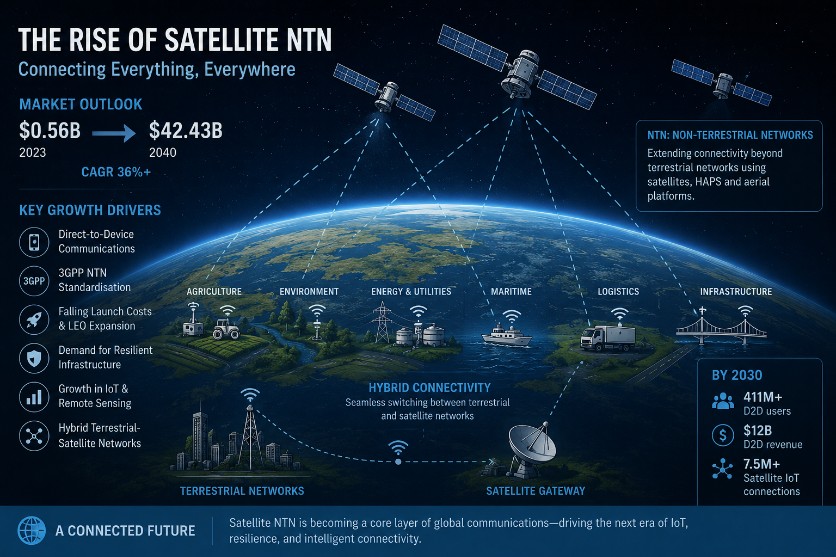
At its core, NTN refers to communications networks delivered via satellites, high-altitude platforms, and aerial systems rather than purely terrestrial cellular infrastructure. In practical terms, it means extending connectivity into the vast areas of the planet where traditional networks either fail economically or simply do not exist.
For years, satellite connectivity was associated with expensive terminals, high-power devices, and specialist industrial deployments. That is changing rapidly.
The Market Is Expanding Beyond Traditional Satellite Communications
The current wave of growth is being driven by several converging trends:
- Direct-to-device satellite communications
- Standardisation through 3GPP NTN specifications
- Falling launch costs and cheaper LEO satellites
- Increasing demand for resilient infrastructure
- Massive growth in remote sensing and IoT deployments
- Hybrid terrestrial-satellite network strategies
Research firm Omdia forecasts that smartphone satellite direct-to-device services alone could reach 411 million monthly active users and generate nearly USD 12 billion in annual revenue by 2030.
Meanwhile, the broader satellite IoT sector continues to accelerate. IoT Analytics estimates the satellite IoT market will grow at a CAGR of 26% through to 2030, surpassing USD 4.7 billion, with satellite IoT connections already reaching 7.5 million in 2024. (iot-analytics.com)
This is no longer purely a defence or maritime story. Agriculture, environmental monitoring, utilities, logistics, mining, energy infrastructure, and blue economy applications are all becoming major drivers of demand.
Direct-to-Device Is Accelerating the Entire Ecosystem
Much of the recent media attention has focused on direct-to-cell services from companies such as SpaceX, AST SpaceMobile and Lynk Global. But the wider impact extends far beyond consumer smartphones.
The race to eliminate terrestrial coverage gaps is now reshaping the telecoms industry itself. This week, Reuters reported that Verizon, AT&T and T-Mobile are planning a joint satellite initiative aimed at ending mobile dead zones using direct-to-device technologies. (Reuters)
That level of investment from incumbent mobile operators signals a major transition: satellite is no longer viewed as a backup network. It is becoming part of mainstream telecommunications architecture.
Academic research is also reinforcing this direction. A recent paper examining Direct-to-Cell and 3GPP NTN architectures argues that hybrid terrestrial-satellite networks are likely to become the foundation for future 6G communications. (arXiv)
Why This Matters for Satellite IoT
While headlines focus on consumer messaging from space, one of the most commercially significant opportunities may actually lie in low-power satellite IoT.
Unlike broadband-focused services, satellite IoT enables tiny packets of data to be transmitted from remote sensors using extremely low power. This opens the door to scalable monitoring across sectors where terrestrial infrastructure is unavailable, unreliable, or economically impractical.
Examples include:
- Soil moisture monitoring in remote agriculture
- River and environmental pollution sensing
- Pipeline and utility monitoring
- Offshore and maritime asset tracking
- Remote weather stations
- Infrastructure monitoring
- Defence and security deployments
For many of these applications, the challenge has never been sensor availability. It has been connectivity.
The emergence of low-cost LEO constellations, LoRaWAN over satellite, NTN-compatible chipsets, and standardised satellite connectivity frameworks is fundamentally changing the economics of remote monitoring.
The Industry Is Moving Toward Hybrid Connectivity
Perhaps the biggest long-term shift is the growing recognition that the future will not be purely terrestrial or purely satellite.
It will be hybrid.
Satellite networks are increasingly being integrated as extensions of terrestrial infrastructure, providing resilience, redundancy, and global reach. This is particularly important for industries operating across remote regions, oceans, border zones, forests, deserts, and mountainous terrain.
The next decade is likely to see:
- Cellular and satellite operators collaborating more closely
- Devices capable of seamlessly switching between terrestrial and NTN coverage
- Massive growth in machine-to-machine satellite communications
- Standardisation reducing hardware costs
- Increasing use of AI and edge analytics at the sensor layer
The opportunity extends far beyond connectivity alone. Reliable access to remote data is becoming a strategic economic asset.
A Defining Decade for Satellite Connectivity
Forecast numbers will inevitably vary between analysts, but the direction of travel is unmistakable.
Satellite NTN is moving from experimental deployments to mainstream infrastructure.
As costs fall, standards mature, and device ecosystems expand, satellite connectivity is increasingly becoming part of the global communications fabric rather than an isolated specialist sector.
For the satellite IoT industry, that creates a rare moment: a convergence of technology maturity, market demand, and infrastructure investment all happening simultaneously.
The result could be one of the most significant expansions in global connectivity since the birth of cellular networks itself.
Sources: Yahoo Finance NTN Report Coverage, Omdia D2D Forecasts, IoT Analytics Satellite IoT Research, Reuters Telecom Satellite JV Report