
The satellite IoT industry has spent the past decade wrestling with a structural problem: most connected devices live in a world of fragmented connectivity. Cellular works well where networks exist. Satellite works where they do not. GNSS provides location, but only if designers integrate a separate chip and antenna stack.
In practice, that has meant more complexity, larger boards, higher costs, and longer development cycles for anyone trying to build devices that truly work everywhere.
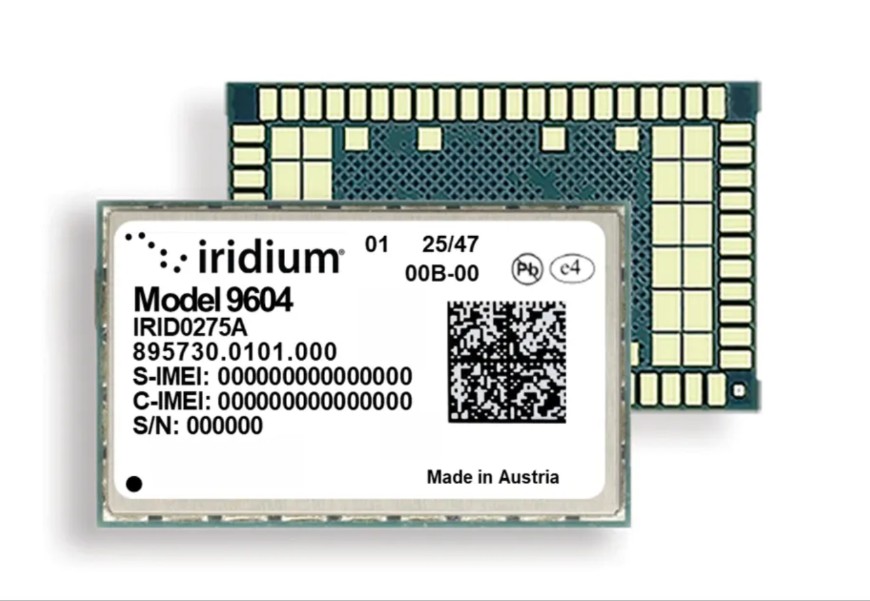
Iridium’s newly announced Iridium 9604 module aims to collapse that complexity into a single piece of hardware. The company has unveiled a compact three-in-one IoT module that integrates Iridium Short Burst Data (SBD) satellite connectivity, LTE-M cellular, and GNSS positioning within one platform.
At first glance, it is a hardware launch. In reality, it signals something bigger: the accelerating shift toward hybrid IoT architectures where devices dynamically move between terrestrial and satellite networks.
A Single Module for Three Networks
The Iridium 9604 is built around a remarkably compact footprint. The module measures just 16 × 26 × 2.4 mm, making it one of the smallest integrated satellite-cellular IoT modules currently announced.
Inside that footprint sits a stack of capabilities that previously required multiple chips:
- Iridium’s Short Burst Data (SBD) satellite service for global messaging
- LTE-M cellular connectivity for terrestrial networks
- Multi-constellation GNSS positioning for location awareness
By integrating these functions, Iridium says device manufacturers can eliminate multiple components from their design, significantly reducing board space and simplifying power management.
For developers building asset trackers, industrial sensors, or remote monitoring equipment, this matters more than the specifications alone might suggest. Historically, combining satellite, cellular, and positioning often meant complex multi-radio architectures and bespoke engineering. That complexity made “always connected” devices expensive and limited them largely to high-value applications.
The 9604 aims to push hybrid connectivity into mass-market IoT deployments.

The Hybrid IoT Model Becomes the Default
The significance of the 9604 lies less in the individual technologies and more in how they work together.
A device using the module can transmit data through cellular networks when coverage exists, then automatically switch to satellite connectivity when it does not. GNSS positioning enables devices to determine their location and make intelligent decisions about which network to use.
In other words, the device itself becomes connectivity-aware.
This “location-aware network selection” is increasingly seen as a core design principle for next-generation IoT hardware. Instead of forcing a device to choose between satellite or terrestrial networks, designers can treat connectivity as a continuum.
For industries operating at the edge of infrastructure, that is transformative.
Where the Module Fits
Iridium is targeting the 9604 at sectors where reliability across multiple connectivity environments is essential. These include:
- Global asset tracking
- Maritime vessel monitoring
- Remote energy infrastructure
- Precision agriculture equipment
- Emergency response and government deployments
In many of these environments, devices spend part of their time inside cellular coverage and part outside it. Ships leave port. Tractors cross fields beyond network coverage. Infrastructure sits in remote landscapes where terrestrial connectivity is patchy at best.
Hybrid connectivity is the logical solution.
A Strategic Pivot for Iridium
The module also reflects a broader strategic shift within Iridium itself.
For years, the company’s IoT offering centred on satellite-only modules using its SBD network. The 9604 marks a move toward multi-mode connectivity platforms, acknowledging that future IoT deployments will rarely rely on a single network technology.
Iridium now effectively offers three connectivity paths within its ecosystem:
- Hybrid satellite-cellular modules like the 9604
- NTN Direct, enabling standards-based direct-to-device connectivity
- Iridium Messaging Transport (IMT) for larger industrial data payloads via Certus hardware
Together, these options position the company across both the proprietary satellite IoT space and the emerging standards-based non-terrestrial network (NTN) ecosystem.
Why This Matters for the Satellite IoT Industry
For the broader satellite IoT sector, the real story is the convergence of networks.
Satellite connectivity is no longer being framed as a niche alternative to terrestrial networks. Instead, it is becoming a native extension of the IoT connectivity stack.
The hybrid approach also reflects a deeper reality: many IoT applications are not purely remote. They operate across changing connectivity environments. Devices move between farms, ports, highways, and infrastructure corridors where coverage varies dramatically.
The companies that succeed in this new phase of IoT will not simply offer satellite connectivity.
They will offer connectivity that adapts to the world itself.
With the 9604, Iridium is betting that the future of IoT hardware will not be satellite or cellular.
It will be both.
And it will fit on a chip barely larger than a postage stamp.