
When people think about military satellites, they tend to picture spy satellites, encrypted communications, missile warning systems or high-resolution imagery. Yet one of the fastest-growing opportunities in defence may be far less glamorous.
Satellite IoT.
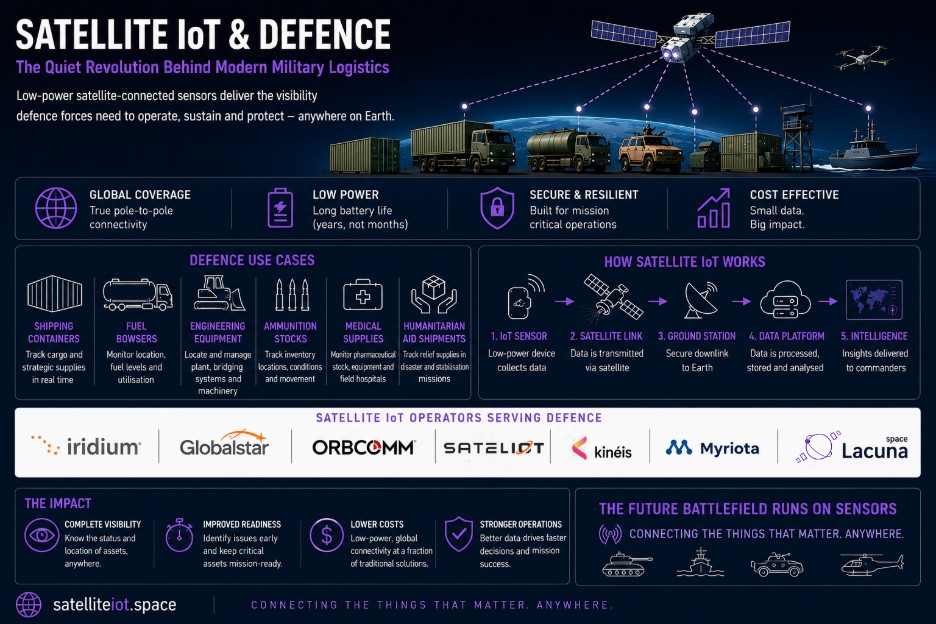
As military forces become increasingly distributed, mobile and data-driven, the ability to monitor equipment, supplies, infrastructure and sensors in remote locations is becoming strategically important. Whether it is a fuel depot in the Arctic, a border monitoring system in Eastern Europe, an ammunition store in the Pacific or a fleet of autonomous maritime drones operating hundreds of miles offshore, military planners are discovering that low-power satellite-connected sensors can provide valuable information at a fraction of the cost of traditional communications systems.
Why Defence Needs Satellite IoT
Modern armed forces manage vast numbers of assets spread across enormous geographic areas.
The challenge is simple. Most military equipment spends the majority of its life parked, stored, transported or waiting to be used. Yet commanders still need to know:
- Where assets are located
- Whether equipment is operational
- Fuel and battery status
- Environmental conditions
- Security and tampering alerts
- Maintenance requirements
Traditional cellular networks rarely provide reliable coverage in remote operating environments. Building dedicated communications infrastructure is expensive and often impossible.
Satellite IoT fills that gap.
Small battery-powered sensors can transmit status updates directly to satellites, providing global visibility without relying on local communications infrastructure.
Defence Use Cases Emerging Today
Military Logistics Tracking
The most immediate opportunity is logistics.
NATO planners often describe logistics as the backbone of military effectiveness. Every vehicle, fuel container, generator, weapons system and shipping container must be accounted for.
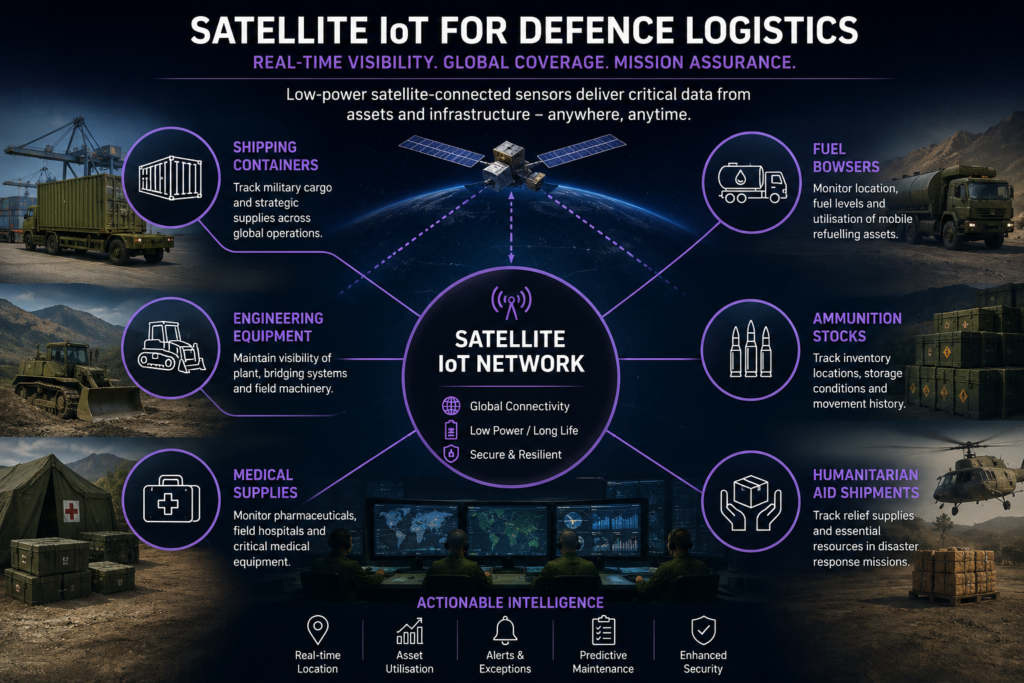
Satellite IoT trackers can provide regular position reports for:
Shipping Containers
Track military cargo, strategic supplies and logistics assets across global operations.
Fuel Bowsers
Monitor fuel levels, utilisation rates and the location of mobile refuelling assets.
Engineering Equipment
Maintain visibility of construction plant, bridging equipment and field engineering assets.
Ammunition Stocks
Track inventory locations, storage conditions and movement of critical munitions.
Medical Supplies
Monitor pharmaceuticals, medical equipment and field hospital inventories.
Humanitarian Aid
Track relief supplies and essential resources during disaster response and stabilisation missions.
Rather than relying on periodic manual reporting, logistics teams can maintain a near-continuous picture of asset availability across entire theatres of operation.
Condition Monitoring of Stored Equipment
Military vehicles can sit in storage for months or years.
A low-cost satellite-connected sensor can monitor:
- Battery voltage
- Humidity
- Temperature
- Vibration
- Fuel levels
- Door opening events
This allows maintenance teams to identify problems before critical equipment is needed during a crisis.
Remote Base Monitoring
Forward operating bases and remote facilities often require infrastructure monitoring.
Typical applications include:
- Water storage levels
- Fuel tank monitoring
- Generator performance
- Environmental monitoring
- Fence and perimeter intrusion detection
Because satellite IoT devices consume very little power, many can operate for years on battery power alone.
Autonomous Systems
Military interest in autonomous systems continues to grow.
Uncrewed surface vessels, unattended ground sensors and remote environmental monitoring stations all require occasional communications even when broadband links are unavailable.
Satellite IoT provides a low-cost method for transmitting health status, position reports and mission data from these systems.
Which Satellite Operators Are Targeting Defence?
Iridium
Iridium remains the dominant player in military satellite communications and is arguably the most established provider of defence-oriented IoT connectivity.
Its global LEO constellation provides true pole-to-pole coverage and is already widely used by military organisations for tracking, telemetry and machine-to-machine communications.
Globalstar
Globalstar has increasingly focused on government and defence applications, highlighting asset visibility, predictive maintenance and operational monitoring for military organisations.
ORBCOMM
ORBCOMM has a long history in satellite machine-to-machine communications and is particularly strong in logistics, maritime tracking and transportation applications that have clear military relevance.
Sateliot
One of the most interesting emerging players.
Sateliot is building a standards-based 5G NTN NB-IoT constellation and has publicly confirmed discussions with European defence ministries regarding military logistics and battlefield support applications. The company has also signed a defence-focused agreement with Indra.
Kinéis
France’s Kinéis positions itself as a sovereign European IoT constellation with secure data handling and strong government appeal. European defence customers are increasingly interested in sovereign alternatives to non-European providers.
Myriota
Myriota‘s ultra-low-power direct-to-orbit architecture is particularly suited to long-life unattended sensors, making it attractive for remote monitoring and infrastructure applications.
Lacuna Space
Although primarily focused on environmental monitoring, utilities and agriculture, Lacuna‘s direct-to-device LoRaWAN architecture is potentially relevant for military infrastructure monitoring, remote sensing, environmental intelligence and logistics applications where small data volumes and multi-year battery life are more important than real-time communications.
The European Sovereignty Question
One trend worth watching is Europe’s growing interest in sovereign communications capability.
Recent geopolitical events have highlighted the risks associated with dependence on a small number of foreign satellite operators. Several European governments are therefore evaluating domestic alternatives for both broadband and IoT connectivity.
This is creating opportunities for European operators including Sateliot, Kinéis and Lacuna Space to support government and defence applications where strategic autonomy is increasingly valued.
The Future Battlefield May Run on Sensors
The future of military operations will depend increasingly on data.
Not every sensor requires broadband connectivity. In many cases, a simple daily update containing location, status, temperature, fuel level or battery condition is enough to improve operational awareness dramatically.
The result is a growing role for satellite IoT alongside traditional military communications systems.
It may not attract the headlines of missile defence systems or reconnaissance satellites, but the ability to connect millions of low-cost sensors across the globe could become one of the most important defence capabilities of the coming decade.