
For years, the satellite IoT industry has been shaped largely by operators in Europe, North America, and Australia. Companies such as Lacuna Space, Astrocast, Myriota and Sateliot have pioneered new approaches to connecting remote sensors and industrial assets beyond the reach of terrestrial networks.
But while much of the industry’s attention has focused on Western operators and emerging 3GPP NTN standards, China may have quietly made one of the most important satellite IoT moves of recent years.
In May 2026, Chinese state media announced that China’s Ministry of Industry and Information Technology (MIIT) had approved the country’s first commercial pilot for satellite-based Internet of Things services. The original reports were remarkably brief, offering little more than a regulatory statement. However, further investigation strongly suggests the approval relates to Beijing Guodian Gaoke Technology Co. and its Tianqi satellite constellation.
That may prove to be a pivotal moment for the global satellite IoT sector.
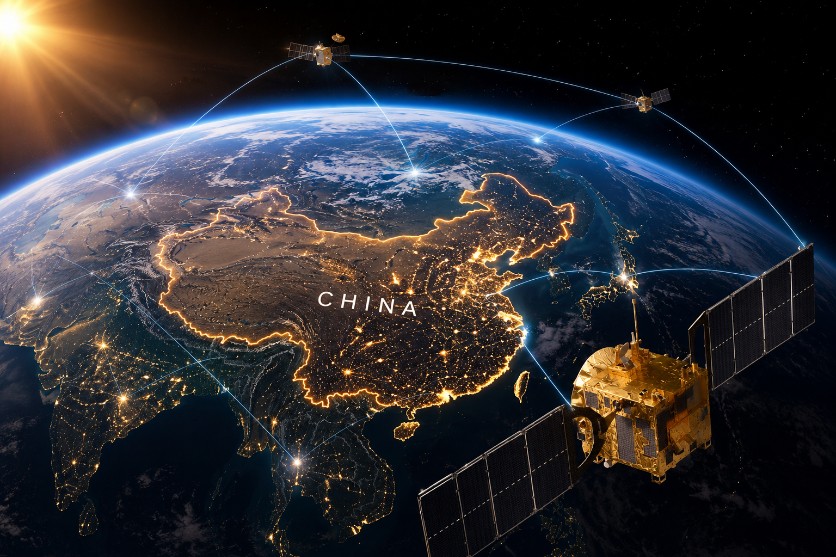
The Tianqi (天启) constellation is already reported to consist of 41 satellites in Low Earth Orbit, making it one of the larger dedicated satellite IoT constellations currently operating anywhere in the world. Chinese reports suggest the network is focused on industrial and infrastructure applications including fisheries, logistics, energy systems, transportation and water resource monitoring. In other words, exactly the kinds of remote, distributed sensing applications that are driving growth across the global satellite IoT market.
What makes this particularly interesting is not simply the existence of another constellation, but the scale and strategic context behind it.
China possesses several advantages that could allow it to become a major force in satellite IoT remarkably quickly:
- large-scale satellite manufacturing capability
- rapid launch cadence
- vertically integrated electronics supply chains
- enormous IoT device production capacity
- strong state-backed industrial digitisation programmes
Until now, China’s satellite IoT ambitions have remained relatively opaque compared with the highly visible activities of Western operators. This commercial pilot approval changes that. Several Chinese reports have described the decision as the first time a private commercial aerospace company has entered China’s core telecommunications operating space. That is a significant regulatory development in its own right.
At the same time, many of the most important technical questions remain unanswered. There is still very little publicly available information in English regarding Tianqi’s protocol stack, spectrum usage, terminal design or interoperability approach. It is not yet clear whether the system is based on NB-IoT NTN standards, a proprietary architecture, a LoRa-derived approach, or an entirely separate Chinese-developed ecosystem.
Sovereign satellite IoT in China
That uncertainty is itself noteworthy. China has often pursued sovereign approaches to telecommunications infrastructure, balancing global interoperability with domestic strategic control. Satellite IoT may now be following a similar trajectory.
For the wider industry, this development could have profound implications. If China scales satellite IoT aggressively, the market may see accelerated hardware commoditisation, lower-cost terminals, faster deployment cycles and increased competition across industrial monitoring sectors. Chinese operators could also become highly influential across Belt & Road markets, particularly in regions where large-scale infrastructure monitoring and environmental sensing are expanding rapidly.
For end users, greater competition could ultimately prove beneficial. More operators entering the market should help drive down connectivity costs and expand the availability of low-power remote monitoring solutions for sectors such as agriculture, utilities, environmental monitoring, logistics and maritime operations.
More broadly, the announcement is another reminder that satellite IoT is no longer a niche extension of terrestrial connectivity. It is increasingly becoming foundational infrastructure for industries that require data from remote, disconnected and difficult-to-reach environments.
The next phase of the satellite IoT market may not simply be defined by technological innovation, but by industrial scale, sovereign infrastructure strategies and competing global ecosystems.
And in that race, China has now very clearly entered the field.