Satellite IoT has spent much of the past decade solving one fundamental problem: how do you connect very small, very low-power devices directly to satellites without making the terminal expensive, power-hungry or cumbersome?
There may be another answer emerging – bring the satellites closer.
Very Low Earth Orbit, or VLEO, generally describes operations below conventional LEO constellations, broadly between around 200 and 450 kilometres above Earth. At these altitudes, satellites encounter enough of the upper atmosphere for aerodynamic drag to become a serious engineering problem. That sounds like a disadvantage. And it is.
But VLEO also offers characteristics that could become highly attractive for satellite IoT: shorter radio links, potentially smaller spacecraft and payloads, lower latency and, importantly, a radically different approach to orbital debris.
So could VLEO become another layer in the emerging satellite IoT ecosystem?
Every kilometre matters when the device is tiny
Consider the basic satellite IoT problem.
A terrestrial IoT sensor may have a tiny antenna, a limited energy budget and batteries expected to last for years. It may be sitting on a water tank, attached to cattle, buried close to the soil or monitoring infrastructure hundreds of kilometres from the nearest cellular tower.
Connecting that device directly to a satellite requires an extraordinarily efficient communications link.
Today’s satellite IoT operators solve this in different ways. Technologies include LoRaWAN LR-FHSS, NB-IoT NTN and proprietary satellite protocols, operating across several spectrum bands and orbital architectures. But all face the same physics. The further away the satellite, the harder the link becomes.
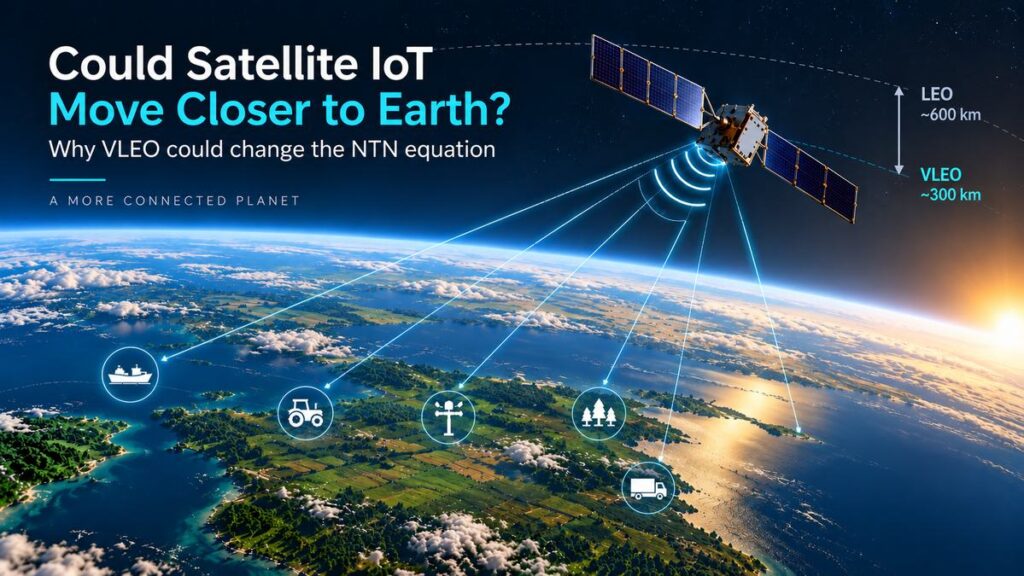
Move a spacecraft from around 600 km to around 300 km and the radio path is substantially shorter. The precise link-budget advantage depends on elevation angle, frequency, antenna characteristics and other factors, but the underlying opportunity is straightforward.
A stronger link can potentially be traded for:
- lower device transmission power
- smaller or less demanding antennas
- improved reliability
- increased data rates
- longer battery life
- smaller satellite antennas or RF systems
For satellite IoT, those are valuable currencies.
The interesting question is therefore not simply whether VLEO improves communications. It does. The question is whether those gains outweigh the considerable cost of keeping a satellite there.
The atmosphere becomes both enemy and friend
Conventional LEO satellites largely operate above the thickest remnants of Earth’s atmosphere. VLEO spacecraft deliberately venture further down.
At perhaps 250-350 km, the atmosphere is extremely tenuous by terrestrial standards. But a spacecraft is travelling at approximately 7.7 kilometres per second. Even individual atmospheric particles become significant when encountered continuously at orbital velocity. The result is drag.
Without propulsion, a VLEO satellite continually loses orbital energy and eventually re-enters the atmosphere.
Solar activity complicates matters further. Heating causes the upper atmosphere to expand, increasing atmospheric density and therefore spacecraft drag.
This means VLEO satellites may require frequent or effectively continuous propulsion simply to remain in orbit.
There is another problem: atomic oxygen.
At these altitudes, ultraviolet radiation breaks molecular oxygen apart, creating highly reactive atomic oxygen. Spacecraft surfaces, polymers, coatings and thermal materials can consequently suffer significant degradation. VLEO therefore demands a different philosophy of spacecraft design.
Satellites can become more aerodynamic, reducing their frontal area. Materials and coatings can be designed specifically for the atomic-oxygen environment. Solar arrays, attitude control and propulsion systems can all be optimised around the fact that the spacecraft is effectively flying through the upper atmosphere.
And propulsion technology may eventually turn the biggest VLEO disadvantage into an advantage.
A satellite that breathes
One of the most intriguing technologies being investigated for VLEO is Air-Breathing Electric Propulsion, or ABEP.
The concept sounds almost counter-intuitive.
Instead of launching all the satellite’s propellant from Earth, an intake captures molecules from the residual atmosphere through which the spacecraft is travelling. Those particles can then be ionised and accelerated electrically to produce thrust.
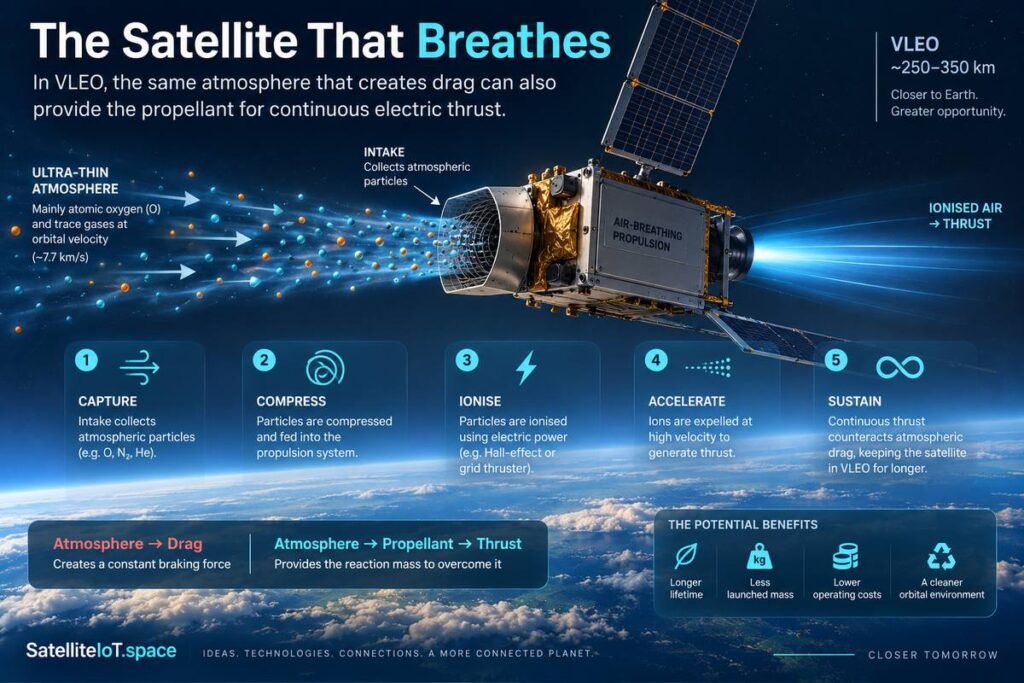
In other words, the atmosphere creating the drag potentially provides the reaction mass used to overcome it.
Atmosphere → drag
but also:
Atmosphere → propellant → thrust
If practical, air-breathing propulsion could remove one of the fundamental limitations on VLEO spacecraft lifetime: the amount of propellant they can carry.
It is still a demanding engineering challenge. Intake efficiency, power generation, thruster performance, atmospheric variability and materials durability all have to work together. But success would make sustained operation much deeper in VLEO considerably more practical.
For satellite IoT, that opens some interesting possibilities.
VLEO doesn’t automatically mean cheaper satellite IoT
There is an important catch. A satellite at 300 km sees less of Earth than a satellite at 600 km. That means a VLEO network generally needs more satellites to provide equivalent geographic coverage and revisit characteristics. For many existing satellite IoT applications, this may make little sense.
Consider a soil sensor on a remote farm that needs to transmit perhaps a handful of measurements several times a day. It doesn’t necessarily care whether its satellite is 300 km or 600 km away, provided the message gets through reliably and economically.
The additional propulsion, power and materials complexity of VLEO could therefore be solving a problem that some existing satellite IoT applications simply don’t have.
But the equation changes as satellite IoT moves towards much larger numbers of devices and more demanding applications.
Direct-to-device communications, higher-frequency reporting, edge intelligence, connected vehicles, autonomous systems, environmental monitoring networks and increasingly capable sensors could all place greater demands on the satellite link.
The distinction between “satellite IoT” and the broader NTN market may also become increasingly blurred.
And that is where VLEO starts becoming particularly interesting.
What happens when satellite IoT reaches billions of devices?
Satellite IoT’s great promise is scale. There are potentially billions of machines, sensors and physical assets beyond reliable terrestrial connectivity.
Agriculture, utilities, logistics, environmental monitoring, energy, maritime operations and infrastructure contain enormous numbers of assets that could eventually become connected.
Supporting that market may ultimately require much greater satellite capacity and potentially much larger constellations.
Which creates another problem. Space debris.
A satellite operating in conventional LEO that fails can remain in orbit for years or, at higher LEO altitudes, considerably longer. Collision fragments can persist even longer, creating hazards for other spacecraft.
VLEO changes that equation.
The same atmospheric drag that makes operating a satellite difficult also provides a natural disposal mechanism.
If propulsion fails:
the satellite loses altitude → atmospheric density increases → drag increases → orbital decay accelerates → the spacecraft re-enters.
A failed satellite therefore does not necessarily become a long-term resident of the orbital environment.
VLEO doesn’t eliminate collision risk. Satellites can still collide and fragments can still threaten other spacecraft while they remain in orbit. But it potentially changes something fundamental. Instead of operating in an orbital environment that can accumulate failures for decades, operators can use an environment that naturally removes them.
For future high-volume satellite networks, that could become an extremely important characteristic.
A new layer in the satellite IoT architecture?
It is unlikely that VLEO will simply replace LEO for satellite IoT.
A more interesting possibility is that satellite IoT develops into multiple orbital layers optimised for different applications.
VLEO could favour high-volume, low-latency communications, direct-to-device services and applications where improved link budgets justify larger constellations and more sophisticated spacecraft. Conventional LEO could continue to be highly effective for low-data-rate IoT, store-and-forward communications and applications where extremely low spacecraft and terminal costs are paramount. Higher orbits would continue serving applications where larger coverage footprints, persistence or different capacity characteristics are more important.
In that world, the question isn’t:
Will VLEO replace LEO satellite IoT?
It is:
Which satellite IoT applications become economically possible when the satellite is only a few hundred kilometres away?
That is a much more interesting question.
Closer may eventually mean smaller
Satellite IoT economics are ultimately driven by scale.
The winning networks will need inexpensive spacecraft, inexpensive launches, inexpensive terminals and very low connectivity costs.
VLEO currently adds complexity to at least one side of that equation: the satellite.
Continuous propulsion, atmospheric drag, atomic oxygen and specialised spacecraft design are formidable challenges. But technology has a habit of turning today’s engineering complexity into tomorrow’s commodity hardware.
If electric propulsion becomes cheaper, atomic-oxygen-resistant materials become standard, spacecraft become aerodynamically optimised and air-breathing propulsion becomes commercially viable, the economics could change rapidly. Then the advantages of operating closer to Earth begin to matter much more. Smaller antennas. Lower transmission power. Smaller payloads. Better links to constrained devices. Lower latency. And orbital environments where failed spacecraft naturally disappear.
For satellite IoT, VLEO therefore deserves attention – not because it is certain to replace today’s networks, but because it could alter some of the fundamental assumptions on which those networks are being built.
Satellite IoT has spent years learning how to make tiny devices communicate with spacecraft hundreds of kilometres overhead. The next breakthrough might come from meeting them halfway.