The ocean economy is entering a new era of digital transformation. From aquaculture and offshore energy to shipping, ports and environmental protection, organisations increasingly depend on data from assets operating far beyond the reach of terrestrial communications networks. Yet vast areas of the world’s oceans remain effectively disconnected.
Satellite IoT is changing that.
Low-power satellite connectivity enables sensors, buoys, vessels and offshore infrastructure to transmit operational and environmental data directly to satellites without relying on cellular towers or expensive traditional satellite terminals. This unlocks new opportunities for real-time visibility, predictive maintenance, sustainability monitoring and autonomous maritime operations. The global Maritime IoT via Satellite market is forecast to grow strongly over the coming decade as industries seek greater operational efficiency and environmental accountability. (dataintelo.com)
For the oceans sector, connectivity is no longer simply about communications. It is becoming the foundation layer for smarter decision-making across the blue economy.
Why Satellite IoT Matters for Oceans
More than 70% of the Earth’s surface is covered by ocean, and much of it lies outside terrestrial network coverage. This creates major operational challenges for organisations managing offshore infrastructure, remote coastlines, marine ecosystems and maritime logistics. Without reliable connectivity, operators often depend on costly vessel visits, delayed reporting cycles and fragmented data collection.
Low-power satellite IoT offers a different approach. Small battery-powered devices can gather data locally and transmit it efficiently during satellite passes, enabling long-life monitoring systems that can operate autonomously for years with minimal maintenance requirements.
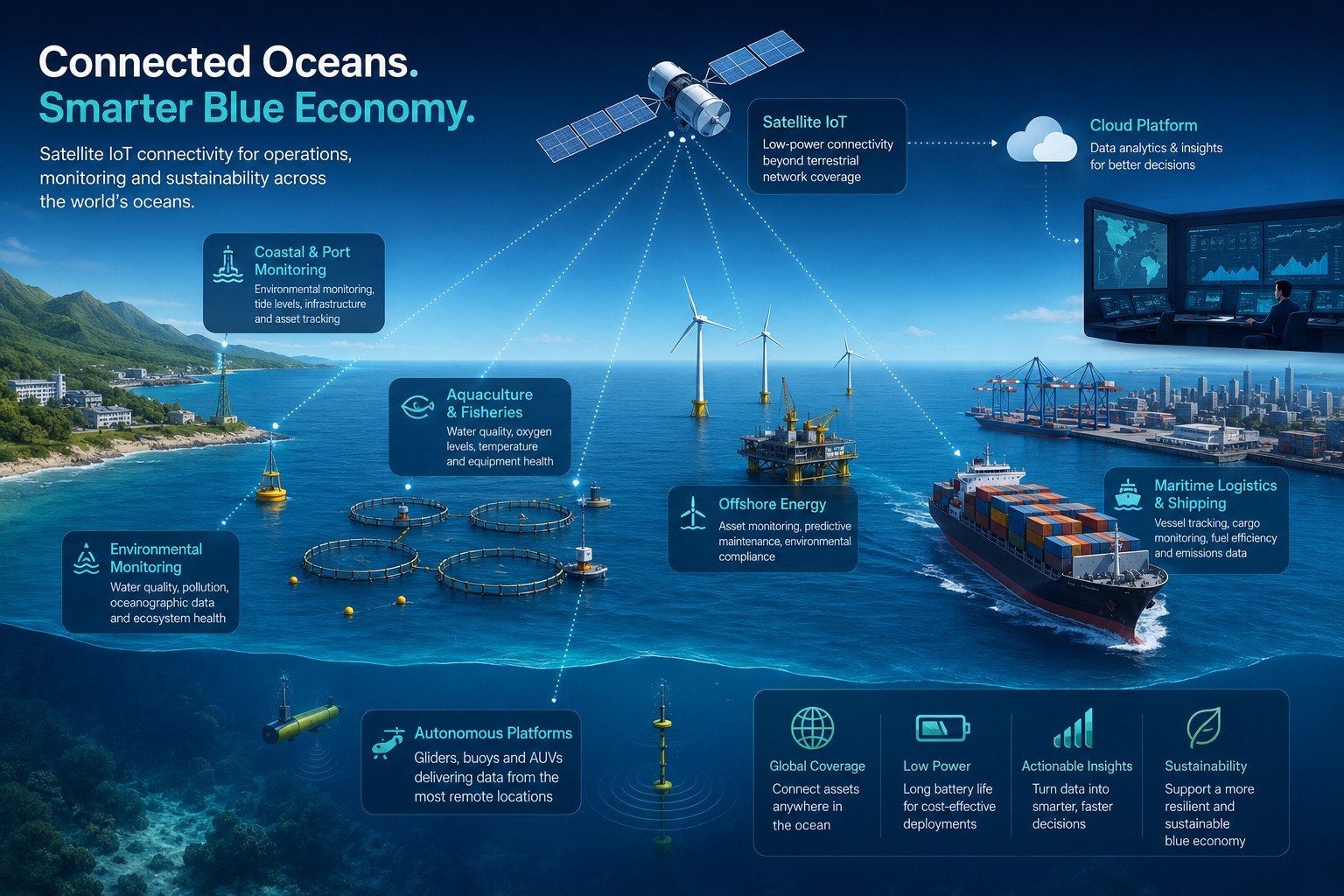
Across the blue economy, satellite IoT is enabling a growing range of applications including:
- Aquaculture and fisheries monitoring
- Offshore energy infrastructure monitoring
- Maritime logistics and shipping visibility
- Oceanographic and environmental sensing
- Coastal infrastructure monitoring
- Remote asset management
The Rise of the Connected Ocean
Aquaculture operators increasingly rely on environmental data to improve yields and reduce operational risk. Offshore wind farms and marine energy systems require continuous monitoring in harsh environments, while shipping operators seek greater visibility across global fleets and cargo movements.
Environmental monitoring is also becoming a major driver for ocean connectivity. Governments, researchers and environmental organisations are deploying increasing numbers of sensors, buoys and autonomous platforms to monitor water quality, coastal erosion, pollution and marine ecosystems. Satellite IoT enables continuous data collection from remote coastal and offshore environments where terrestrial infrastructure is impractical or non-existent.
Traditional maritime satellite communications systems are often expensive, power-hungry and poorly suited to large-scale deployments of low-cost sensors. New generations of low-power satellite IoT networks are specifically designed for small data payloads transmitted from distributed remote devices. This allows organisations to deploy compact, battery-powered monitoring systems capable of operating for years while transmitting valuable operational and environmental data from even the most isolated ocean environments.
The Future of the Blue Economy
The future ocean economy will be increasingly data-driven. Autonomous vessels, smart ports, offshore renewable energy, digital aquaculture and large-scale environmental monitoring all depend on reliable connectivity beyond terrestrial network coverage.
Satellite IoT is becoming a critical enabling layer for this transformation, allowing organisations to digitise operations across some of the most remote and challenging environments on Earth.
As maritime industries seek greater sustainability, resilience and operational intelligence, low-power satellite connectivity will play a central role in connecting the blue economy.
Agriculture
Crop risk, irrigation, microclimate, disease early-warning, remote assets — farm-scale data you can act on.
Explore →Environmental Monitoring
Watersheds, air quality, wildfire indices, protected areas — where “coverage gaps” are the point.
Explore →Energy & Utilities
Distributed assets, fault detection, grid edges — resilient comms for infrastructure that can’t go dark.
Explore →Ocean Economy
Fisheries, ports, offshore operations — tracking, safety, and compliance beyond coastal coverage.
Explore →Defence
Field logistics, remote perimeter sensing, asset accountability — secure-by-design patterns for tough environments.
Explore →Logistics
Condition + location across containers, fleets, and cold chain — fewer blind spots across corridors and sea routes.
Explore →River Systems
Leakage, abstraction, reservoirs, quality — operationally “boring” monitoring that’s financially decisive.
Explore →Infrastructure
Roads, rail, bridges, pipelines — structural signals, maintenance triggers, and asset health across wide geographies.
Explore →Mining & Extractives
Remote sites, environmental monitoring, asset telemetry and operational visibility in some of the world’s harshest environments.
Explore →