Mining and extractive industries operate in some of the world’s most remote and challenging environments. From open-pit mines and mineral exploration sites to oil, gas and quarry operations, reliable connectivity is often difficult, expensive or entirely unavailable.
Yet modern extractive operations increasingly depend on data.
Operators require continuous visibility across equipment, environmental conditions, fuel systems, infrastructure and workforce safety systems to improve efficiency, reduce downtime and meet growing sustainability and regulatory requirements. In many cases, however, terrestrial communications infrastructure simply does not extend to where operations are taking place.
Satellite IoT is helping close that gap.
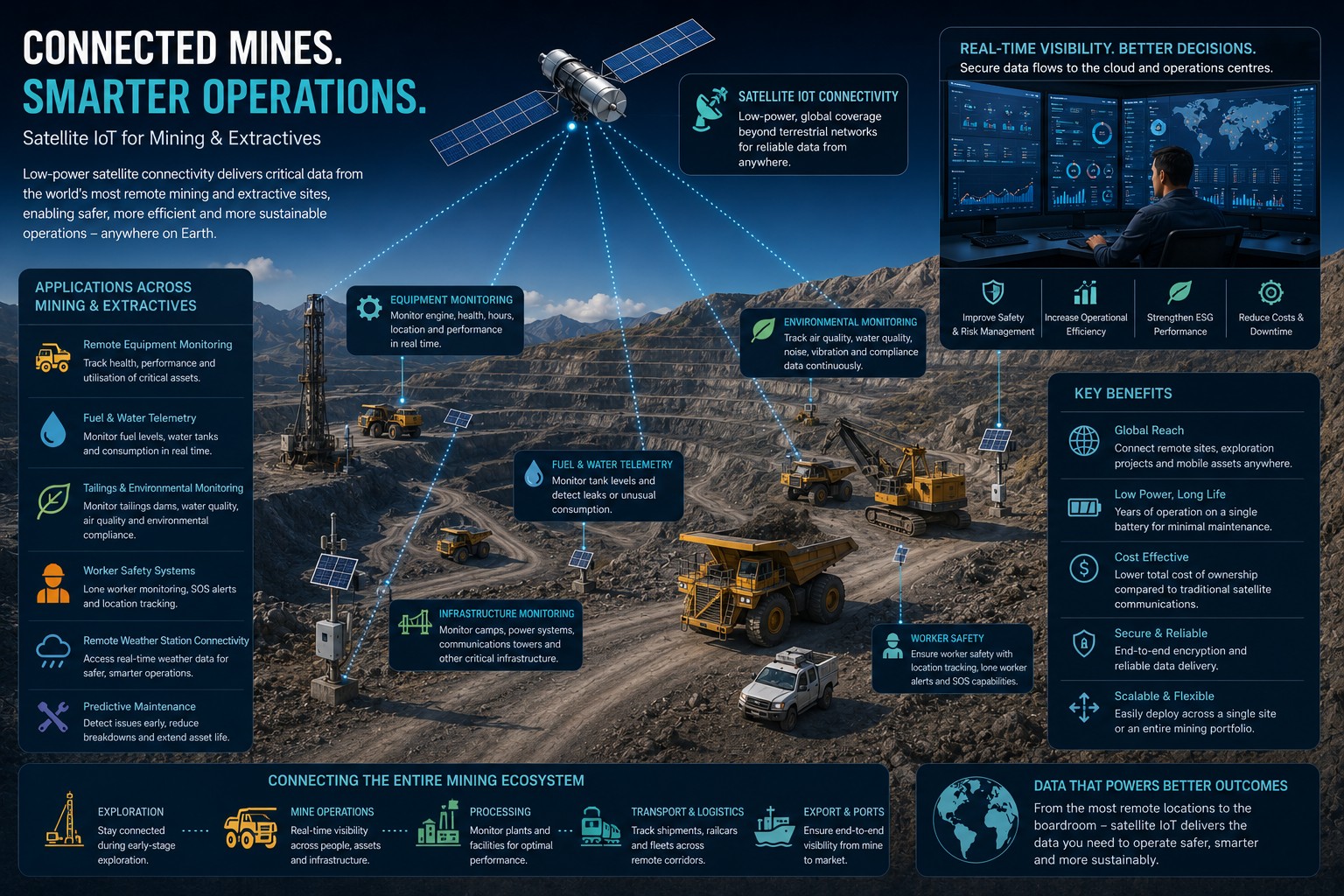
Low-power satellite connectivity enables sensors and remote monitoring devices to transmit operational and environmental data directly to satellites from almost anywhere on Earth. This allows mining and extractive operators to maintain visibility across remote sites without relying entirely on cellular or terrestrial network infrastructure.
Why Satellite IoT Matters for Mining
Extractive industries face a unique combination of operational challenges. Sites are often geographically isolated, environmentally harsh and operationally complex. Equipment failures, environmental incidents or disruptions to logistics can have major financial and safety consequences.
Traditional monitoring approaches frequently rely on manual inspections, local telemetry systems or expensive high-bandwidth satellite communications solutions. These approaches can leave operational blind spots and increase the cost and complexity of monitoring large distributed sites.
Low-power satellite IoT provides a scalable alternative for gathering small but valuable operational data from remote assets and infrastructure.
Connecting Remote Operations
Mining operations depend on continuous awareness of conditions across vehicles, fixed infrastructure and environmental systems.
Satellite IoT enables compact, battery-powered devices to transmit data from remote assets even when terrestrial connectivity is unavailable. This can include:
- Equipment status and utilisation
- Fuel tank levels
- Water management systems
- Tailings dam monitoring
- Environmental compliance data
- Remote weather conditions
- Security and access monitoring
Because low-power satellite IoT systems are optimised for small data transmissions and long battery life, they can support large-scale sensor deployments across wide operational areas with minimal supporting infrastructure requirements.
Supporting Safety, Sustainability & Efficiency
The mining sector faces increasing pressure around operational safety, environmental accountability and ESG performance.
Satellite IoT can help operators improve visibility into environmental risks, infrastructure condition and operational performance across remote sites. Continuous monitoring supports earlier detection of issues such as equipment failures, water management problems or environmental anomalies.
The technology also helps reduce unnecessary site visits and maintenance journeys, improving operational efficiency while reducing costs and emissions associated with remote operations.
For exploration projects and temporary sites, low-power satellite IoT offers a rapid deployment model without the need for permanent terrestrial communications infrastructure.
The Future of Connected Extractive Operations
Mining and extractive industries are becoming increasingly automated and data-centric. Autonomous vehicles, remote operations centres and predictive maintenance systems all depend on reliable data flows from assets operating across isolated environments.
Satellite IoT is becoming an important enabling layer for this transition, helping operators maintain visibility across sites where traditional networks remain limited or impractical.
By combining global coverage, low energy requirements and scalable deployment models, low-power satellite IoT is helping create safer, more efficient and more sustainable extractive operations for the future.
Agriculture
Crop risk, irrigation, microclimate, disease early-warning, remote assets — farm-scale data you can act on.
Explore →Environmental Monitoring
Watersheds, air quality, wildfire indices, protected areas — where “coverage gaps” are the point.
Explore →Energy & Utilities
Distributed assets, fault detection, grid edges — resilient comms for infrastructure that can’t go dark.
Explore →Ocean Economy
Fisheries, ports, offshore operations — tracking, safety, and compliance beyond coastal coverage.
Explore →Defence
Field logistics, remote perimeter sensing, asset accountability — secure-by-design patterns for tough environments.
Explore →Logistics
Condition + location across containers, fleets, and cold chain — fewer blind spots across corridors and sea routes.
Explore →River Systems
Leakage, abstraction, reservoirs, quality — operationally “boring” monitoring that’s financially decisive.
Explore →Infrastructure
Roads, rail, bridges, pipelines — structural signals, maintenance triggers, and asset health across wide geographies.
Explore →Mining & Extractives
Remote sites, environmental monitoring, asset telemetry and operational visibility in some of the world’s harshest environments.
Explore →