Energy and utility networks form the backbone of modern economies, yet much of their critical infrastructure operates far from reliable connectivity. Power lines traverse remote terrain, pipelines run across sparsely populated regions, and water networks extend into rural and underground environments where terrestrial communications are inconsistent or absent. Satellite IoT provides a resilient means of maintaining visibility across these distributed assets, ensuring that operational data continues to flow regardless of location.
As utilities transition toward more decentralised, data-driven operations, the ability to monitor assets continuously rather than periodically is becoming essential. Satellite IoT enables this shift by extending connectivity to the outer edges of the network, where failures are often hardest to detect and most costly to resolve.
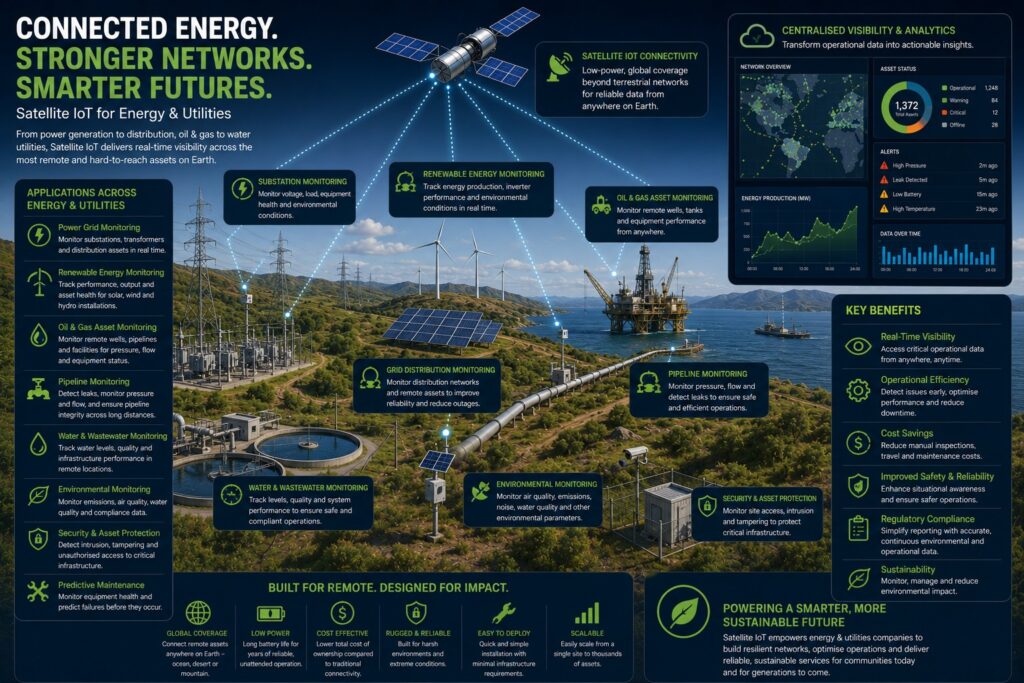
Sector Overview
Energy and utility systems are characterised by scale, complexity and ageing infrastructure. Operators must manage generation, transmission and distribution assets across vast geographies while maintaining service reliability and regulatory compliance. Traditional monitoring approaches rely heavily on scheduled inspections, fixed communication infrastructure and reactive maintenance models.
Satellite IoT introduces a complementary layer of connectivity that allows operators to deploy sensors wherever they are needed, rather than where networks already exist. This supports a move toward condition-based monitoring, where decisions are informed by real-time data rather than fixed maintenance cycles. In sectors such as water, electricity and gas, this transition is closely linked to efficiency targets, sustainability goals and regulatory frameworks.
Key Use Cases
Pipeline and network monitoring is a primary application of satellite IoT within utilities. Sensors can detect pressure changes, flow anomalies and potential leaks along pipelines that may run for hundreds of kilometres through remote terrain. Satellite connectivity ensures that these signals are transmitted reliably, enabling faster response and reducing environmental and financial impact.
Electricity grid monitoring also benefits from satellite IoT, particularly in rural or hard-to-access areas. Sensors installed on poles, transformers and substations can report on load conditions, faults and environmental stress. This supports improved fault detection, reduces outage duration and enhances overall grid resilience.
Water network management is another significant use case. Monitoring flow, pressure and reservoir levels across distributed systems helps utilities identify leakage, optimise distribution and manage demand. Satellite IoT is especially valuable for assets located beyond cellular coverage, including trunk mains, remote pumping stations and rural treatment facilities.
How Satellite IoT Fits Operationally
Utility data is typically characterised by low data volumes transmitted at regular intervals or triggered by threshold events. This aligns well with satellite IoT technologies designed for efficient, low-power communication. Devices can operate for extended periods on battery power or small solar installations, reducing the need for frequent maintenance.
In practice, satellite IoT is often integrated alongside terrestrial communication systems. High-density urban areas may rely on cellular or fibre networks, while satellite connectivity provides coverage for remote or critical assets where redundancy is required. This hybrid approach ensures continuity of service and reduces dependence on any single communication infrastructure.
Commercial Value
- Reduced operational expenditure through fewer manual inspections and site visits
- Faster fault detection and response, minimising downtime and service disruption
- Lower non-revenue losses in water and energy networks through improved visibility
- Extended asset life through condition-based maintenance strategies
- Reduced need for costly terrestrial communication infrastructure in remote areas
Challenges
Deploying satellite IoT within energy and utility environments requires careful consideration of integration with existing operational systems, including SCADA platforms and asset management tools. Power supply remains a constraint for certain deployments, particularly where solar harvesting is not viable. Data security and regulatory compliance are also critical, as utility infrastructure is often classified as national critical infrastructure. Selecting appropriate data transmission intervals is essential to balance responsiveness with cost and energy consumption.
Looking Ahead
Satellite IoT is expected to play an increasingly central role in the digital transformation of utilities. The convergence of satellite and terrestrial standards is improving interoperability and simplifying deployment. Advances in edge intelligence are enabling devices to process data locally and transmit only actionable insights. As coverage expands and service costs continue to decline, satellite IoT is becoming a standard component of utility network design, supporting more resilient, efficient and sustainable infrastructure systems.
Agriculture
Crop risk, irrigation, microclimate, disease early-warning, remote assets — farm-scale data you can act on.
Explore →Environmental Monitoring
Watersheds, air quality, wildfire indices, protected areas — where “coverage gaps” are the point.
Explore →Energy & Utilities
Distributed assets, fault detection, grid edges — resilient comms for infrastructure that can’t go dark.
Explore →Ocean Economy
Fisheries, ports, offshore operations — tracking, safety, and compliance beyond coastal coverage.
Explore →Defence
Field logistics, remote perimeter sensing, asset accountability — secure-by-design patterns for tough environments.
Explore →Logistics
Condition + location across containers, fleets, and cold chain — fewer blind spots across corridors and sea routes.
Explore →River Systems
Leakage, abstraction, reservoirs, quality — operationally “boring” monitoring that’s financially decisive.
Explore →Infrastructure
Roads, rail, bridges, pipelines — structural signals, maintenance triggers, and asset health across wide geographies.
Explore →Mining & Extractives
Remote sites, environmental monitoring, asset telemetry and operational visibility in some of the world’s harshest environments.
Explore →