Modern defence and security operations increasingly depend on data from remote, contested and infrastructure-poor environments. Whether monitoring critical infrastructure, tracking assets, securing borders or supporting deployed personnel, the ability to gather and transmit data reliably has become a strategic advantage.
Yet many defence operations still face significant connectivity gaps.
Large areas of land, maritime zones and remote operational theatres remain outside terrestrial network coverage. Traditional satellite communications systems can provide high-bandwidth links for command and control, but they are often too expensive, power-hungry or impractical for large-scale deployment across distributed sensors and low-power field devices.
Low-power satellite IoT offers a different model.
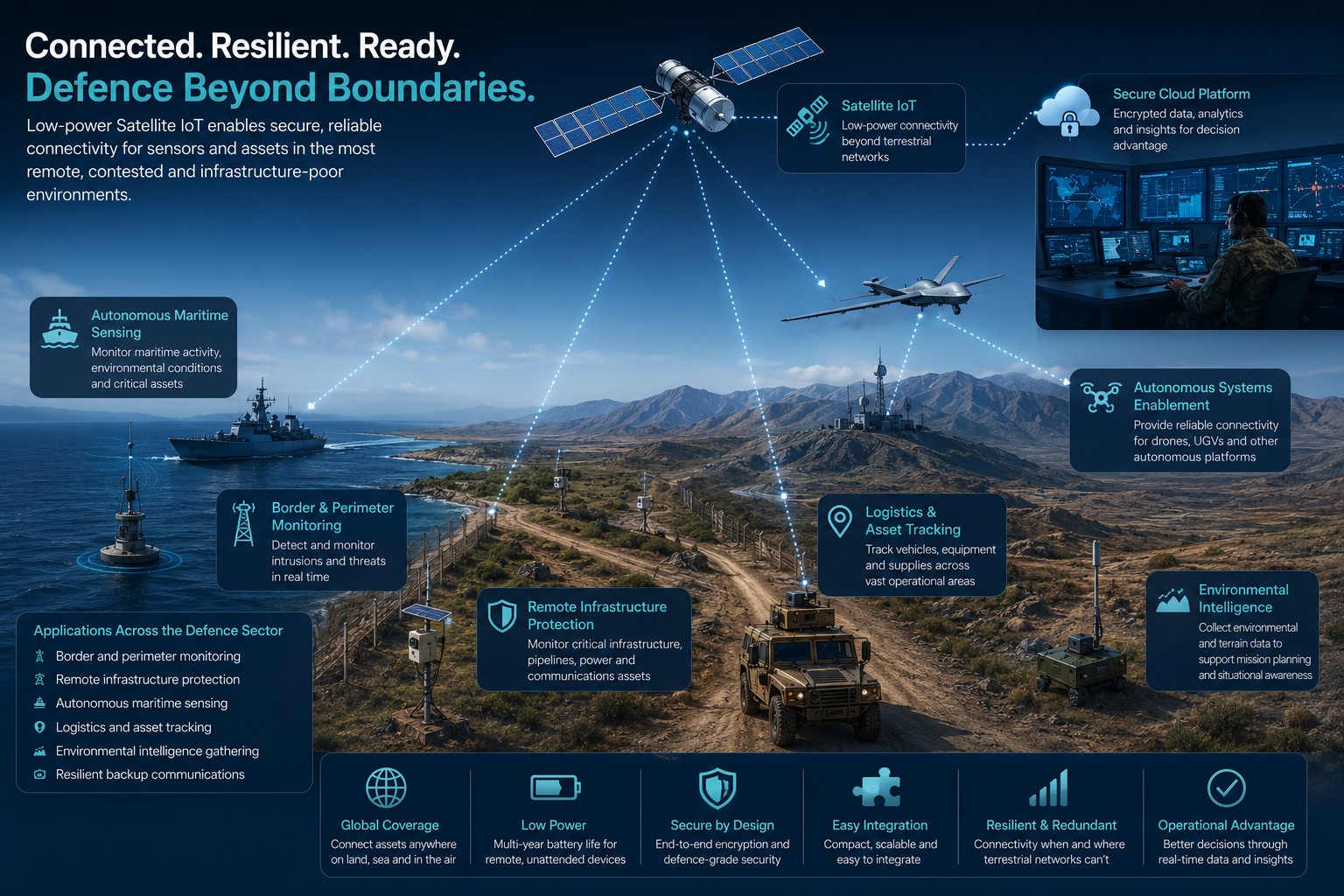
By enabling small sensors and remote assets to transmit data directly to low Earth orbit satellites, defence organisations can deploy resilient monitoring systems across vast geographic areas with minimal infrastructure requirements. This creates new opportunities for persistent sensing, operational awareness and autonomous monitoring in locations where conventional connectivity is unavailable or unreliable.
Why Satellite IoT Matters for Defence
Modern defence operations increasingly rely on distributed data collection. Remote sensors, autonomous systems and field-deployed monitoring equipment all generate valuable operational intelligence, but without reliable connectivity much of this data remains inaccessible in real time.
Low-power satellite IoT enables secure, energy-efficient communications for devices operating in isolated environments, allowing defence organisations to maintain visibility across remote infrastructure, operational assets and environmental conditions.
Applications are rapidly expanding across the sector, including:
- Border and perimeter monitoring
- Remote infrastructure protection
- Autonomous maritime sensing
- Logistics and asset tracking
- Environmental intelligence gathering
- Resilient backup communications
Resilient Connectivity Beyond Terrestrial Networks
Defence infrastructure often operates in areas where terrestrial connectivity is weak, unavailable or vulnerable to disruption. Remote training areas, offshore assets, border regions and deployed operational environments may have little or no cellular coverage at all.
Satellite IoT enables organisations to deploy low-power sensors capable of operating autonomously for years while transmitting small but valuable data payloads directly to satellites. This can include equipment status updates, environmental monitoring data, intrusion alerts, logistics information or operational telemetry.
Because these systems are designed for low data volumes and energy efficiency, they can support highly distributed deployments across wide operational areas without requiring extensive supporting infrastructure.
Supporting Autonomous and Distributed Operations
The defence sector is increasingly moving towards autonomous and distributed operational models. Autonomous surface vessels, remote environmental sensing platforms, unattended ground sensors and distributed logistics systems all require reliable low-power connectivity to function effectively.
Satellite IoT supports these evolving operational concepts by providing communications resilience beyond terrestrial networks. In contested or degraded environments, this can offer an important additional layer of operational flexibility and redundancy.
The technology also supports dual-use opportunities across defence, civil resilience and critical national infrastructure protection, particularly where remote monitoring and low-power sensing requirements overlap.
The Future of Defence Connectivity
As defence operations become more data-driven, the importance of resilient and globally available connectivity will continue to grow. The future battlefield and wider security environment will increasingly depend on networks of sensors, autonomous platforms and distributed intelligence systems operating across land, sea and remote infrastructure environments.
Low-power satellite IoT is becoming an important part of this evolving communications landscape, helping defence organisations extend operational awareness into locations where traditional networks cannot easily reach.
By combining global coverage, low power requirements and scalable deployment models, satellite IoT has the potential to become a critical enabling technology for next-generation defence and security operations.
Agriculture
Crop risk, irrigation, microclimate, disease early-warning, remote assets — farm-scale data you can act on.
Explore →Environmental Monitoring
Watersheds, air quality, wildfire indices, protected areas — where “coverage gaps” are the point.
Explore →Energy & Utilities
Distributed assets, fault detection, grid edges — resilient comms for infrastructure that can’t go dark.
Explore →Ocean Economy
Fisheries, ports, offshore operations — tracking, safety, and compliance beyond coastal coverage.
Explore →Defence
Field logistics, remote perimeter sensing, asset accountability — secure-by-design patterns for tough environments.
Explore →Logistics
Condition + location across containers, fleets, and cold chain — fewer blind spots across corridors and sea routes.
Explore →River Systems
Leakage, abstraction, reservoirs, quality — operationally “boring” monitoring that’s financially decisive.
Explore →Infrastructure
Roads, rail, bridges, pipelines — structural signals, maintenance triggers, and asset health across wide geographies.
Explore →Mining & Extractives
Remote sites, environmental monitoring, asset telemetry and operational visibility in some of the world’s harshest environments.
Explore →