River Systems & Water Monitoring
Rivers are among the world’s most important natural infrastructure systems. They support agriculture, drinking water supplies, industry, hydropower generation, biodiversity and flood protection for billions of people worldwide.
Yet many river systems remain poorly monitored.
Across large parts of the world, water authorities, environmental agencies, utilities and researchers still struggle to gather reliable real-time data from remote rivers, tributaries and catchment areas. Monitoring equipment is often deployed far beyond terrestrial network coverage, creating major challenges for continuous environmental monitoring and operational visibility.
Satellite IoT is helping change that.
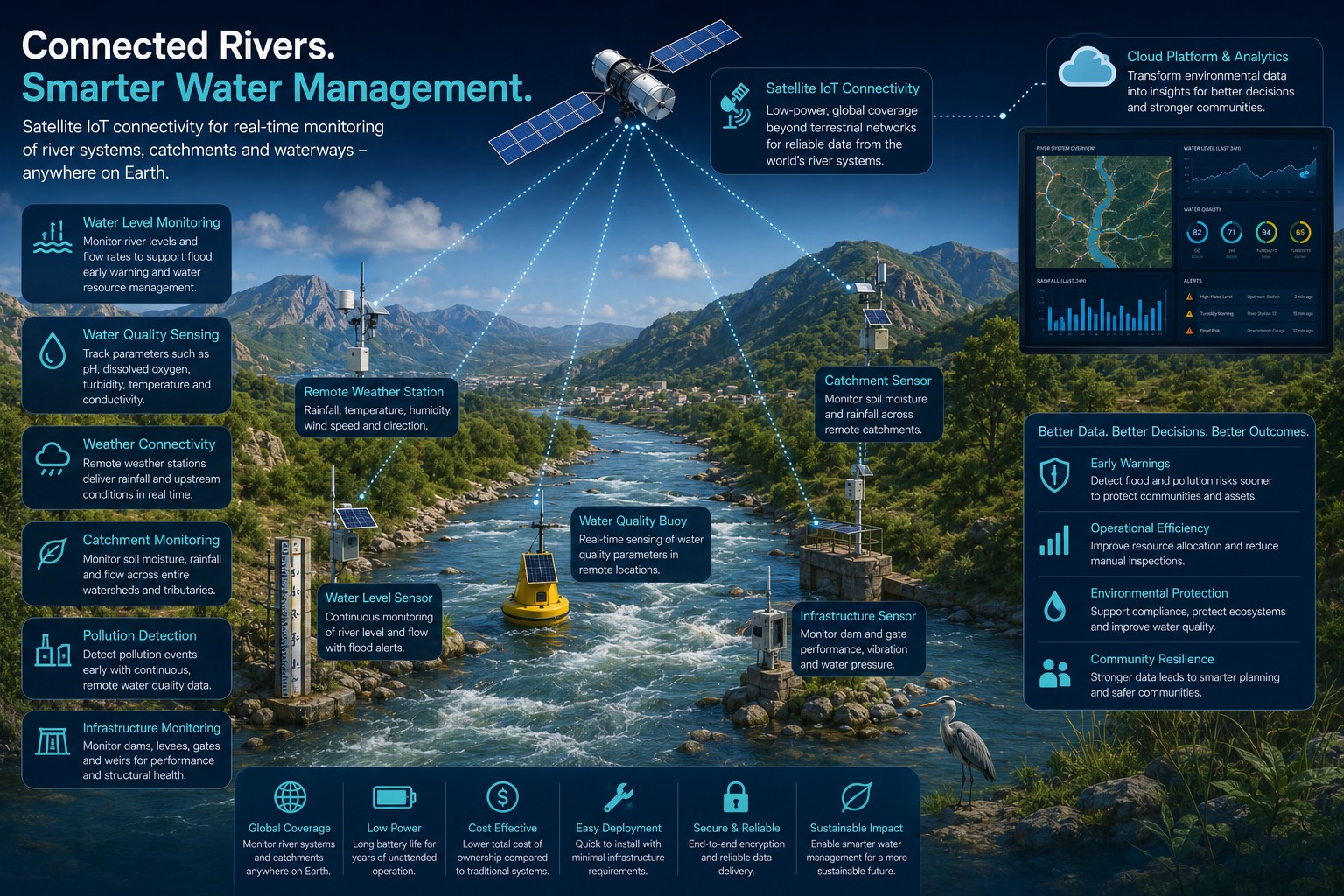
Low-power satellite connectivity enables sensors deployed along rivers and waterways to transmit environmental data directly to satellites without relying on cellular infrastructure. This allows organisations to maintain visibility across remote river systems, floodplains and catchment areas where traditional communications networks are unavailable or unreliable.
Why Satellite IoT Matters for River Systems
River systems are dynamic and highly sensitive to environmental change. Flooding, pollution events, drought conditions and ecosystem degradation can develop rapidly, often in remote areas where data collection is difficult.
Traditional monitoring approaches frequently rely on manual inspections or local telemetry systems with limited coverage. In many regions, this results in fragmented datasets, delayed reporting and reduced ability to respond quickly to emerging environmental risks.
Low-power satellite IoT enables distributed monitoring systems that can operate autonomously for years while transmitting small but valuable data payloads from remote sensing locations.
Applications across the sector include:
- Flood and water level monitoring, river water quality sensing, remote weather station connectivity, catchment and watershed monitoring, pollution detection and hydrological infrastructure monitoring.
Enabling Real-Time Environmental Visibility
Continuous environmental visibility is becoming increasingly important as climate change drives more extreme weather events and greater pressure on water resources.
Satellite-connected river monitoring systems can support measurement of:
- Water levels and flow rates
- Rainfall and upstream weather conditions
- Water temperature
- pH, dissolved oxygen and turbidity
- Nitrogen and phosphate run-offs
- Flood risk indicators
- Infrastructure condition monitoring
This allows authorities and operators to improve early warning systems, support environmental compliance programmes and build more resilient water management strategies.
Because satellite IoT systems are designed for low power consumption and small data transmissions, they are particularly well suited to remote environmental deployments where devices may need to operate unattended for many years.
Supporting Smarter Water Management
Governments, utilities and environmental agencies increasingly require better data to support long-term water management planning.
Satellite IoT enables broader deployment of monitoring infrastructure across entire river catchments, including areas where terrestrial connectivity is unavailable or economically impractical. This can help improve understanding of watershed dynamics, identify pollution incidents earlier and support more effective flood response planning.
The technology also supports research organisations and conservation projects seeking continuous environmental data from ecologically sensitive or geographically isolated locations.
The Future of Connected River Systems
As environmental pressures increase, river systems will require increasingly sophisticated monitoring and management capabilities.
The future of water management will depend on continuous data flows from distributed environmental sensors operating across large and often remote geographic areas. Satellite IoT is becoming an important enabling technology for this transition, helping connect river systems that have historically remained data-poor.
By combining global coverage, low energy requirements and scalable deployment models, low-power satellite IoT is helping create smarter, more resilient and more sustainable approaches to river system monitoring and environmental management.
Agriculture
Crop risk, irrigation, microclimate, disease early-warning, remote assets — farm-scale data you can act on.
Explore →Environmental Monitoring
Watersheds, air quality, wildfire indices, protected areas — where “coverage gaps” are the point.
Explore →Energy & Utilities
Distributed assets, fault detection, grid edges — resilient comms for infrastructure that can’t go dark.
Explore →Ocean Economy
Fisheries, ports, offshore operations — tracking, safety, and compliance beyond coastal coverage.
Explore →Defence
Field logistics, remote perimeter sensing, asset accountability — secure-by-design patterns for tough environments.
Explore →Logistics
Condition + location across containers, fleets, and cold chain — fewer blind spots across corridors and sea routes.
Explore →River Systems
Leakage, abstraction, reservoirs, quality — operationally “boring” monitoring that’s financially decisive.
Explore →Infrastructure
Roads, rail, bridges, pipelines — structural signals, maintenance triggers, and asset health across wide geographies.
Explore →Mining & Extractives
Remote sites, environmental monitoring, asset telemetry and operational visibility in some of the world’s harshest environments.
Explore →