
Much of the debate around AI in agriculture is framed the wrong way. The real question is not whether AI can transform farming, but whether agriculture will finally generate the volume, continuity, and quality of data that AI requires to be genuinely useful.
For decades, that constraint has quietly capped innovation.
Agriculture remains one of the least digitised major industries on Earth. Data is sparse, localised, seasonal, and often anecdotal. Soil samples are taken a few times a year. Weather stations are tens of kilometres apart. Crop inspections rely on human observation. Decisions are made with experience and intuition – impressive, hard-won, and fragile at scale.
AI does not struggle because farms are too complex. It struggles because farms have been largely invisible to machines.
Satellite IoT changes that.
AI Is Only as Powerful as the Data Beneath It
AI systems do not create insight from nothing. They learn patterns from reality – repeated, measured, timestamped reality. Until recently, agriculture simply could not supply that at scale, especially beyond the reach of cellular networks.
Satellite IoT removes that barrier.
By enabling low-power sensors to operate anywhere on Earth – fields, orchards, rangeland, forests, rivers, storage sites, and remote plantations – satellite IoT turns agriculture into a continuously reporting system. Soil moisture, leaf wetness, temperature, humidity, rainfall, water levels, animal movement, disease pressure, and infrastructure status become streams of data rather than occasional snapshots.
Once this digitisation is in place, AI stops being speculative. It becomes operational.
From “Not Ready” to Inevitable
Skepticism about AI in farming often sounds familiar. It is not accurate enough. Nature is too complex. What happens when systems fail?
These concerns are understandable – and historically predictable.
In the 1930s, farmers debating mechanisation struggled to imagine farming without horses. Tractors were seen as expensive, unreliable, and unsuitable for mixed farms. What they could imagine was substitution – horses replaced by machines – not transformation: single combines harvesting thousands of acres, precision spraying, satellite imagery, or autonomous guidance.
The same cognitive anchors are at work today. When productivity improvements arrive gradually, we extrapolate linearly. But digitisation followed by AI is not linear – it is exponential.
Satellite IoT accelerates this curve by ensuring AI systems are trained not on assumptions, but on the real, messy complexity of agriculture, captured continuously over years and across geographies.
Why Satellite IoT Changes the AI Equation
Most AI tools in agriculture today are constrained by patchy inputs. Satellite IoT solves four foundational problems simultaneously.
Coverage. Farms do not stop at the edge of mobile networks. Satellite IoT works everywhere.
Continuity. AI improves when it sees seasons, anomalies, failures, and recoveries – not just averages.
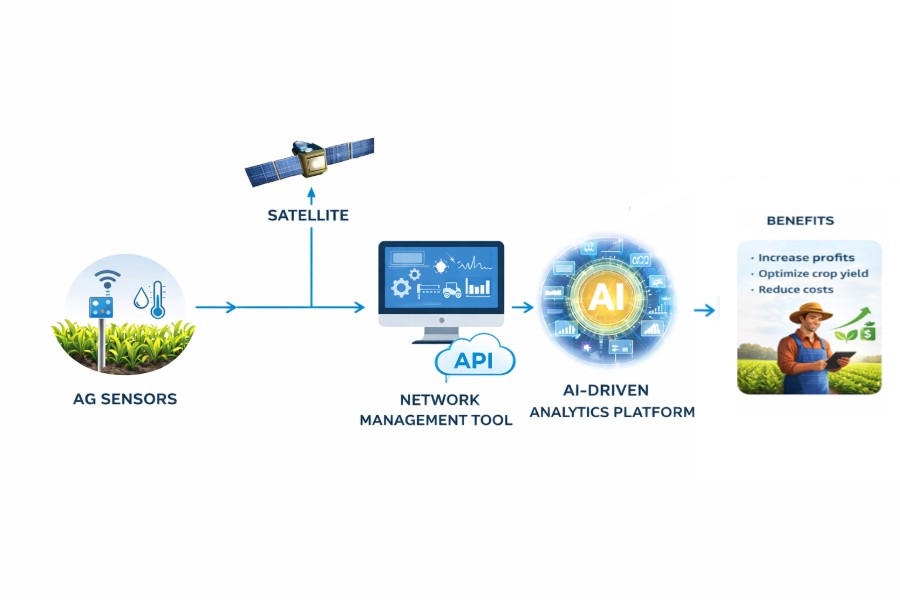
Ground truth. Models trained on satellite imagery alone struggle without in-field validation. Sensors anchor AI to physical reality.
Scale. When thousands – or millions – of devices report daily, AI systems can detect weak signals long before humans can.
The result is a shift from reactive farming to anticipatory agriculture: predicting disease before symptoms appear, optimising irrigation before stress occurs, managing inputs dynamically rather than uniformly.
Productivity, Sustainability, and Optionality
The implications extend far beyond labour efficiency.
Digitised agriculture enables measurable sustainability. Water use becomes optimisable. Inputs become targetable. Emissions, nutrients, and soil health become quantifiable rather than estimated. This data is not just operational – it is economic, regulatory, and strategic.
Countries and regions that digitise agriculture first will build better AI models, attract agritech capital, develop exportable technologies, and produce food more efficiently and sustainably. Those that wait will import both the technology and the competitive disadvantage.
Innovation does not require consensus. It requires a beachhead.
The Quiet Infrastructure Behind Agricultural AI
AI will not replace farmers. But it will increasingly replace guesswork, routine monitoring, and delayed response. The farms that benefit first will not be the ones debating whether AI is ready, but the ones quietly digitising their operations today.
Satellite IoT is not the headline act. It is the infrastructure that makes the headline possible.
At satelliteiot.space, we track the networks, platforms, devices, and data ecosystems enabling this transformation – because the future of agricultural AI will be written not in algorithms alone, but in the data flowing up from the soil, the crops, and the landscape itself.