Environmental monitoring increasingly underpins regulatory compliance, climate resilience and long-term resource management. Governments, utilities, conservation bodies and infrastructure operators all rely on timely, defensible data to understand how natural systems are changing and to respond before damage becomes irreversible. Yet many of the environments that matter most are remote, sparsely populated or deliberately left without infrastructure. Satellite IoT enables continuous environmental intelligence precisely where terrestrial connectivity is weakest or non-existent.
By extending digital visibility into rivers, forests, coastlines, wetlands and protected landscapes, satellite IoT supports a shift from episodic measurement toward persistent observation. This transition is critical as environmental risks become more dynamic, interconnected and costly to ignore.
Sector Overview
Environmental systems operate across wide spatial scales and long time horizons. Water quality can degrade upstream before impacts are felt downstream, land subsidence may develop gradually before becoming catastrophic, and pollution events often occur far from population centres. Traditional monitoring approaches rely heavily on manual sampling, fixed stations with limited backhaul, or delayed data retrieval, all of which constrain responsiveness.
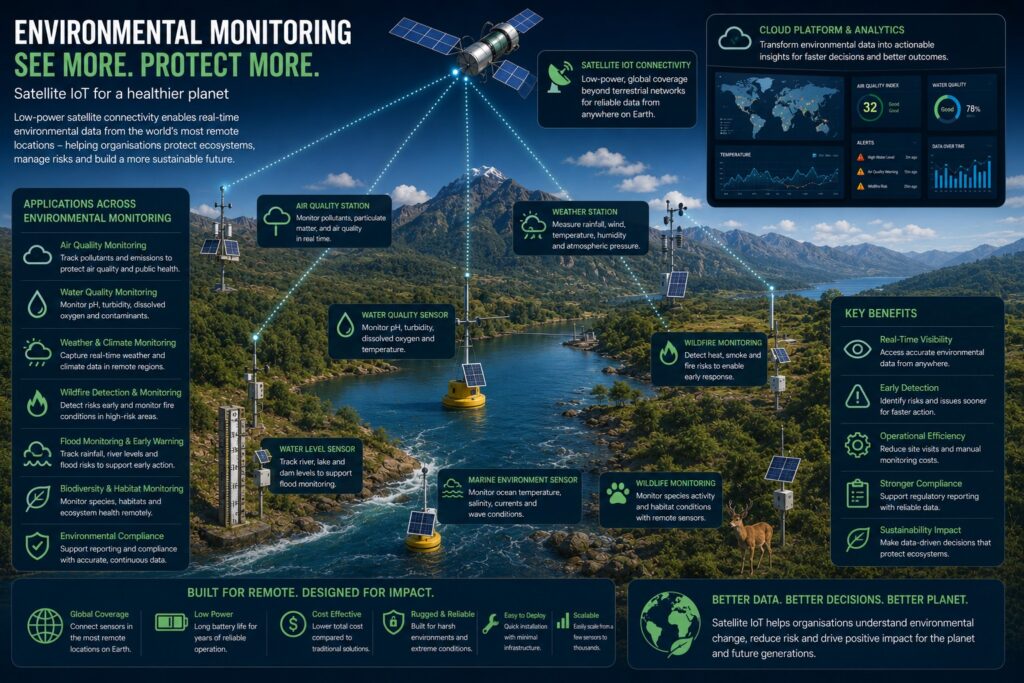
Satellite IoT provides a practical means of collecting low-volume sensor data continuously from distributed locations. Sensors deployed in rivers, soil, air and coastal zones can transmit readings at defined intervals regardless of terrain, ownership boundaries or network availability. This creates a consistent, auditable data layer that supports early warning, trend analysis and evidence-based intervention.
Key Use Cases
Water quality monitoring is one of the most common applications of satellite IoT in environmental contexts. Sensors measuring parameters such as turbidity, temperature, conductivity and dissolved oxygen can be deployed along river catchments, reservoirs and outfalls. Satellite connectivity ensures that pollution events or threshold breaches are detected quickly, even in remote upland or rural areas.
Flood and hydrological monitoring is another critical use case. River level sensors, rainfall gauges and soil saturation probes provide early indicators of flood risk when combined with hydrological models. Satellite IoT enables these sensors to operate reliably in locations where floods are most likely to originate rather than where connectivity happens to exist.
Air quality and atmospheric monitoring also benefit from satellite IoT, particularly for tracking particulate matter, gas concentrations and microclimatic conditions in hard-to-reach locations. This is increasingly relevant for wildfire risk assessment, industrial compliance monitoring and understanding the localised impacts of climate change.
How Satellite IoT Fits Operationally
Environmental monitoring typically involves small data payloads transmitted at regular or event-driven intervals. This aligns well with low-power satellite IoT architectures designed for long device lifetimes and minimal maintenance. Devices are often deployed in exposed or inaccessible locations, making reliability and power efficiency more important than high data throughput.
In many cases, satellite IoT complements existing monitoring networks. Terrestrial sensors may provide dense coverage in urban or accessible areas, while satellite-connected devices extend reach into upstream, offshore or protected zones. This hybrid approach supports continuity of data across entire ecosystems rather than isolated segments.
Commercial Value
- Reduced reliance on manual sampling and site visits in remote locations
- Earlier detection of pollution events, enabling faster mitigation
- Improved regulatory compliance through continuous, time-stamped records
- Lower infrastructure costs compared with building terrestrial backhaul
- Stronger evidence base for long-term environmental planning and policy
Challenges
Environmental monitoring deployments must contend with harsh physical conditions, including flooding, corrosion, biofouling and extreme temperatures. Power autonomy remains a central design constraint, as devices may need to operate unattended for years. Data integration can also be complex, particularly where monitoring programmes span multiple agencies or legacy systems with differing data standards. Selecting appropriate transmission intervals is critical to ensure timely alerts without unnecessary power consumption or operational cost.
Looking Ahead
The role of satellite IoT in environmental monitoring is set to expand as climate pressures intensify and regulatory scrutiny increases. Standardisation of device protocols and data formats is improving interoperability across monitoring networks. Advances in edge analytics are enabling sensors to detect anomalies locally and transmit only when meaningful change occurs. At the same time, expanding satellite coverage and improving economics are making continuous environmental monitoring feasible at national and even continental scale, rather than being limited to isolated pilot projects.
Related satellite IoT applications
| Resource | Why it matters |
|---|---|
| Satellite IoT use cases | Explore the main applications for satellite IoT, including asset tracking, remote monitoring, environmental sensing, infrastructure visibility and low-power data collection beyond cellular coverage. |
| Satellite IoT operators | Compare the companies providing satellite IoT connectivity, including LoRaWAN, NB-IoT NTN, L-band, proprietary LPWAN and hybrid network approaches. |
| Satellite IoT protocols | Understand the connectivity technologies used for satellite IoT, including LoRaWAN, NB-IoT NTN, L-band messaging, direct-to-satellite IoT and other low-data protocols. |
| Satellite IoT glossary | Get clear definitions of the key terms used across the sector, from LEO and NTN to LPWAN, payloads, store-and-forward messaging and direct-to-device connectivity. |
| Satellite IoT network management | Learn how devices, gateways, messages, coverage, provisioning and data flows are managed across satellite-connected IoT deployments. |
| Satellite IoT data analytics | See how remote sensor data is converted into operational insight, alerts, dashboards and decision support for organisations working beyond terrestrial coverage. |
Agriculture
Crop risk, irrigation, microclimate, disease early-warning, remote assets — farm-scale data you can act on.
Explore →Environmental Monitoring
Watersheds, air quality, wildfire indices, protected areas — where “coverage gaps” are the point.
Explore →Energy & Utilities
Distributed assets, fault detection, grid edges — resilient comms for infrastructure that can’t go dark.
Explore →Ocean Economy
Fisheries, ports, offshore operations — tracking, safety, and compliance beyond coastal coverage.
Explore →Defence
Field logistics, remote perimeter sensing, asset accountability — secure-by-design patterns for tough environments.
Explore →Logistics
Condition + location across containers, fleets, and cold chain — fewer blind spots across corridors and sea routes.
Explore →River Systems
Leakage, abstraction, reservoirs, quality — operationally “boring” monitoring that’s financially decisive.
Explore →Infrastructure
Roads, rail, bridges, pipelines — structural signals, maintenance triggers, and asset health across wide geographies.
Explore →Mining & Extractives
Remote sites, environmental monitoring, asset telemetry and operational visibility in some of the world’s harshest environments.
Explore →